The Shape of Being
For a long stretch of my early life, I lived in a kind of drifting fog. I was moving, but not going anywhere. I was working, but not building anything. People talk about being lost like it is poetic or cinematic. Mine was neither. Mine was a slow, quiet erosion, the feeling of waking up every day inside a life that did not feel like mine, wearing a body that had no map.
It did not help that I had no real male role models. No blueprint for adulthood. No one to show me how to navigate the world with intention. What I had instead was the constant refrain of “When will you grow up?” I heard it so young and so often that it became a kind of prophecy. I was expected to know how to manage money, how to make decisions, how to set a path, how to “be a man,” even though no one had ever shown me how. It is honestly a miracle I turned out the way I did. Mostly out of fear, and partly out of a deep-seated need to prove to everyone, and maybe to myself, that I could make something out of nothing, even when surrounded by doubters and naysayers.
In those early years, my jobs reflected that searching. They read like the résumé of someone trying on different lives to see if any of them fit. I stocked sweaters at Old Navy until my hands felt like cardboard (how many times can you listen to Mariah Carey’s Christmas song before wanting to stick a pencil in your ear?). I worked as a music venue lackey, hauling cases, mopping floors, doing anything except touching the stage lights. I sold waiting-room art door to door, carrying a laminated binder that bent in the heat. I wore the Radio Shack polo and pretended I understood the difference between cables. I bussed sticky tables at Village Inn. I cooked delivery pizzas. I worked in a western wear fulfillment warehouse stuffing cowboy boots into boxes. I was a call center agent for AT&T Long Distance, then at Progressive Insurance, where the fluorescent lights and hold music dulled the soul. I even almost ended up in a vacuum pyramid scheme, sitting through the pitch meeting one signature away from selling overpriced plastic to unsuspecting families.
Then, in one of life’s strangest plot twists, I wound up working as a staff assistant at the International Monetary Fund, surrounded by economists discussing macroeconomic policy like it was oxygen. Me, someone who barely understood how to do basic math, pretending to hold my own in a world I had no business stepping into. It was a futile attempt at adulthood through the lens of business and economics, and I knew even then that I was playing a role that did not belong to me while trying to measure up to expectations my family had laid out for me.
Somewhere in that blur was the Austin airport La Quinta. They handed me the keys to the shuttle van like I was a functioning adult. I still think about that sometimes. A 19-year-old version of me, lost as hell, responsible for delivering travelers safely to the airport while I had absolutely no direction of my own.
Moving to Austin was not glamorous. It was a survival school. I had no sense of time management. I had never learned how to budget. I was constantly broke, constantly calculating whether rent or food mattered more that week. I became resourceful out of necessity. I filled gallon Ziploc bags and a backpack at the all-you-can-eat pizza buffet to stock my fridge for days at a time. I walked out smelling like grease, sweat and anxiety, praying no one stopped me. It sounds ridiculous now, but that was how I stayed alive.
Looking back, every one of those jobs and humiliations taught me something real. They taught me what it meant to be underestimated. They taught me how people treat you when they think you are temporary. They taught me the grit that comes from being dismissed. They taught me resilience in the old-fashioned, bloody-knuckled way.
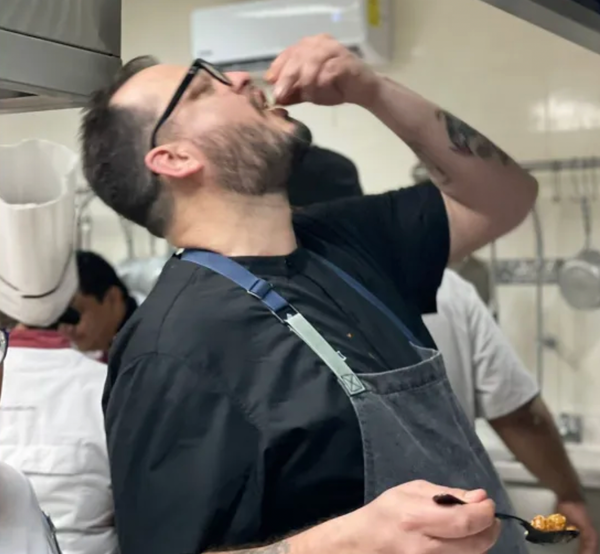
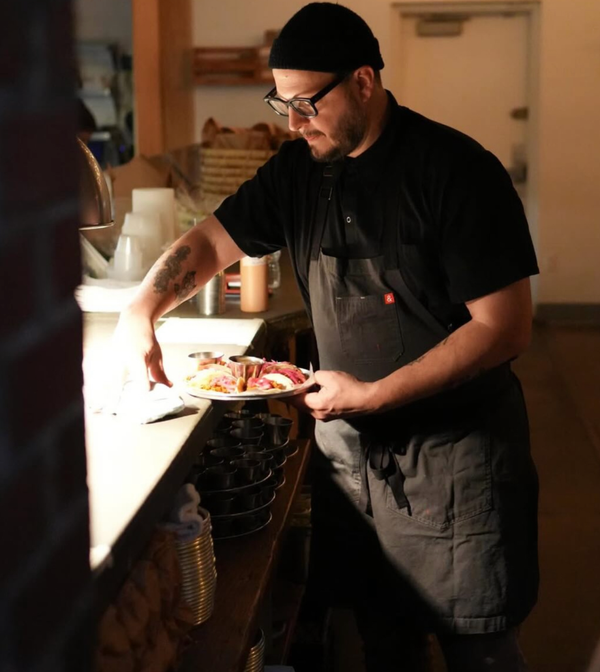
Then cooking returned to me. Not as a job but as a truth. Kitchens became a reflection of myself that I recognized. The heat and the pressure made sense. The rhythm made sense. The transformation made sense. Where every other job had made me feel like an impostor, cooking made me feel like a person.
The real shift came when I realized no one was coming to rescue me. No mentor, no relationship, no opportunity was going to teach me how to build a life. The work had to be mine. The growth had to be mine. The discipline and maturity had to come from inside, not through the approval or guidance of anyone else.
Teaching others has continuously sharpened that realization. Being of service grounded me. Mentoring cooks and younger folks has taught me more about myself than any self-help book ever could. Helping someone else grow always forces me to confront the parts of myself I have neglected or ran away from. When I created space for someone else to step into their power, I stepped into mine.
Becoming is not linear. It is a spiral. It drags you backward just as you move forward. It forces you to revisit the versions of yourself you abandoned. It asks you to honor them before outgrowing them. The boy filling Ziploc bags with pizza. The Old Navy retail worker. The call center agent. The warehouse kid. The IMF impostor. The shuttle driver. Every one of them mattered. I did not grow despite those years, I grew because of them.
Somewhere along the way, the fog lifted. The drifting stopped. The reflection in the mirror began to look like someone who had survived enough to know how to live.
La Ofrenda: Frijoles de la Casa
Simple. Soulful. Nourishing. The food that carried you before you knew how to carry yourself.
These beans are not a side dish. They are a foundation. They are memory. They are resilience in edible form. This is the kind of food that fed generations long before you found your footing, and the kind of food that continues to ground you now.
Ingredients
For the Beans
- 2 cups dried pinto beans, rinsed
- 8 cups water
- 1 small white onion, halved
- 4 garlic cloves, smashed
- 2 tablespoons lard or neutral oil
- 1 teaspoon kosher salt, plus more to taste
For the Seasoned Finish (Amparo style)
- 2 tablespoons lard or oil
- 1 garlic clove, minced
- 1 serrano chile, finely sliced
- 1 teaspoon freshly ground black pepper
- 1 teaspoon chile powder
- Salt to taste
For Serving Warm tortillas, queso fresco, chopped cilantro, lime wedges
Instructions
1. Cook the beans. Place rinsed beans in a large pot with the water, halved onion, smashed garlic, and lard. Bring to a boil, then lower to a gentle simmer. Cook uncovered for 1 and a half to 2 hours, or until the beans are soft and creamy. Add salt during the last 20 minutes of cooking. Remove the onion halves and discard - unless you're blending them. Then blend everything together.
2. Season the beans (the Amparo way). In a small sauté pan, heat lard over medium heat. Add minced garlic and serrano and cook until fragrant but not browned. Add black pepper and paprika, stirring to bloom the spices. Pour this mixture directly into the pot of beans and stir well.
3. Adjust. Taste and season. If the beans are too thick, add warm water. If too thin, simmer uncovered until reduced to a rich broth.
4. Serve. Ladle into bowls. Top with queso fresco, cilantro, and a squeeze of lime. Serve with warm tortillas to scoop, swipe, and savor every bite.
Chef’s Note
These beans are humble, but not simple. They are the food of survival and the food of arrival. They are the dish you make when you need grounding, when you want to remember where you came from, when you want to feel nourished in a way that has nothing to do with luxury.
They are the reminder that transformation does not require extravagance. Just a little intention.