The Philosophy of Mise en Place
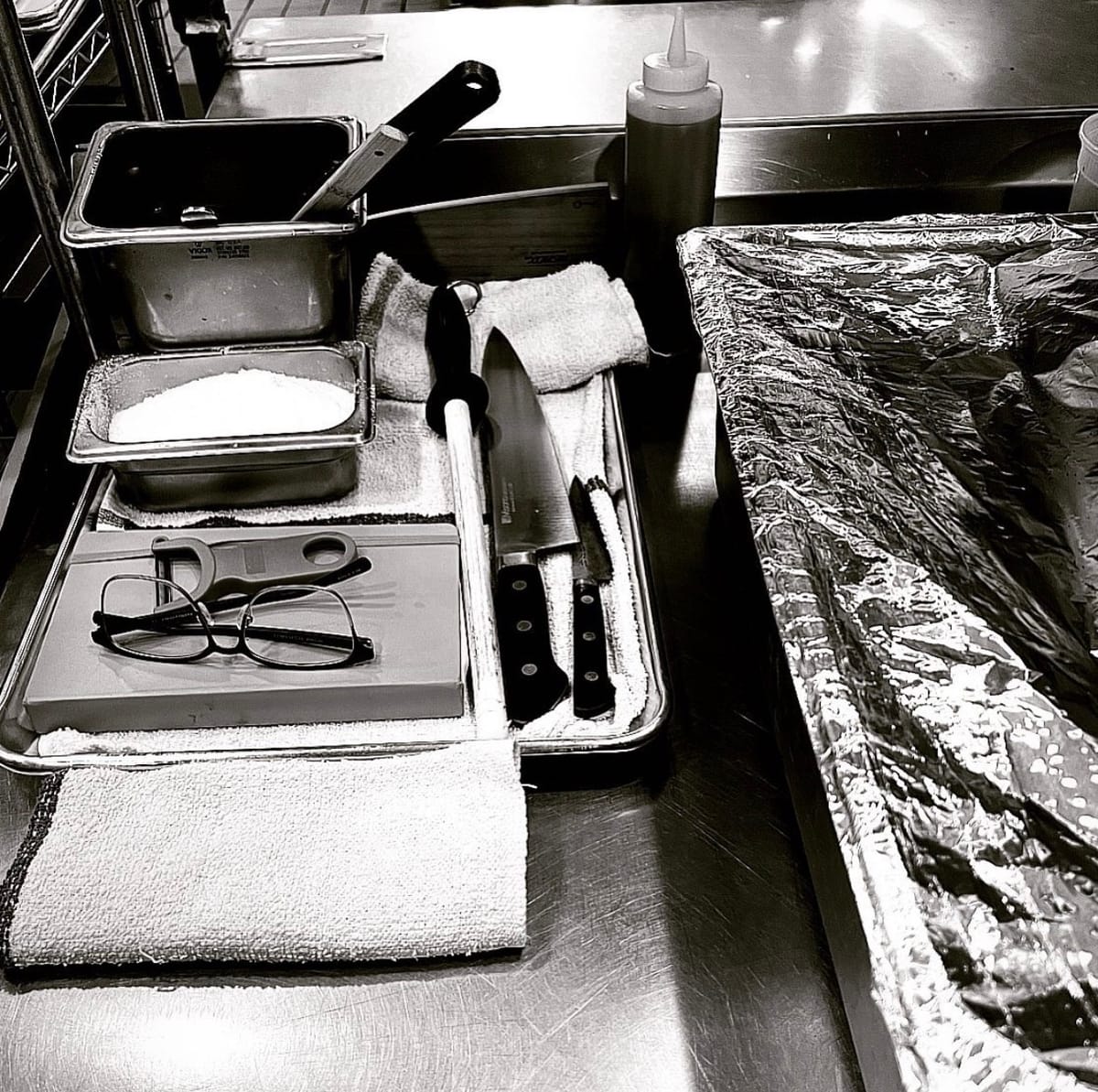
Mise en place: French for “everything in its place.” It comes from the old European brigades, long before modern restaurants, when order was the only thing standing between a cook and complete fucking collapse during service. It wasn’t a concept; it was survival. It was the understanding that the smallest detail, a knife angled wrong, a garnish not prepped, a towel missing, could turn a smooth service into a war zone.
For generations, mise en place has been the heartbeat of kitchen life. The quiet work before the storm. The discipline that makes artistry possible. The reason a team can feed 200 people in two hours without burning the whole place down. It’s not glamorous, it’s not instagrammable, but it’s the backbone of every plate, every service, every miracle pulled off in a kitchen. Without mise, there is no restaurant, just noise and heat and ego.
And yet, the deeper I go into this industry, the more kitchens I run, the more cooks I mentor, the more chaos I navigate, the more I realize mise isn’t just a restaurant principle. It’s a life philosophy I keep chasing but never quite catch.
Because in the kitchen, mise makes me invincible. Outside the kitchen, I’m just a guy trying not to drown in my own disorganized bullshit.
In the restaurant, I can see the order in everything. I can walk in half-asleep and instantly know someone moved the deli cups. I can track a missing hotel pan like a bloodhound. I can hear if a sound is missing or a new one has arrived uninvited. I can taste a sauce and know which cook’s mise is off. There’s clarity in that world, a structure built on repetition, discipline, and the sacred ritual of being ready before the chaos hits.
But in my personal life? Mise disappears.
My apartment? A crime scene.My inbox? A graveyard.My brain some days? A walk-in after a hungover dishwasher put everything away blindfolded.
And that’s when I realized something important. Something I wish I’d understood years ago: Mise en place isn’t just about where your shit goes. It’s about where you go. Where your thoughts go. Where your emotions go. Where your attention goes.
Because mise isn’t physical, it’s psychological. It’s emotional. It’s behavioral. And if your inner mise is off, I don’t care how sharp your knives are, you’re fucked.
Mental mise en place is the part no one teaches you in culinary school, and oftentimes also not at home. It’s the part old-school chefs never talked about because they were too busy screaming, but it’s the part that makes or breaks you as a leader.
If you lose your mental mise: your calm, your clarity, your emotional restraint, you lose the entire plot:
- You stop listening.
- You stop communicating with intention.
- You react instead of respond.
- You confuse control with leadership.
- You let ego drive the bus straight into a ditch.
And your team feels it immediately. The kitchen feels it. Hell, the food feels it. Worst of all, the guest feels it.
The second you lose your internal mise, everything around you unravels. Silently at first, then spectacularly. And if you’re leading people? It’s even worse because leadership amplifies everything. Your discipline, your insecurity, your fear, your sharpness, your softness. Your mise isn’t just yours anymore; it affects everyone on the line. If your mindset is messy, your team becomes messy. If your emotions are out of place, your directions become unclear. If your communication is sloppy, your culture collapses.
That’s why I obsess over the smallest shit with young cooks. Not because I care about perfect towels. Not because I’m a control freak. Not because I want the station to look pretty.
But because the smallest habits save your life when the world catches fire. Because mise isn’t about cleanliness — it’s about readiness. And readiness is about respect.
I’ve watched cooks blow off mise their whole career until one chaotic Saturday night humbles the fuck out of them. Until they’re reaching for something that isn’t there. Until they’re drowning in tickets and looking at me like, “Chef, help.”
And all I can say is: “If your mise had been there, it would’ve helped you.”
There’s no shortcut. You learn mise the same way you learn pain — through experience.
The paradox is that I can teach (whether they listen to me or not) a kitchen full of people how to set themselves up for success… while still struggling to set my own life up with the same intention.
Because mise en place in life is harder. There’s no prep list for heartbreak. No station diagram for mental health. No designated spot for grief, loneliness, exhaustion, or ambition. Life doesn’t behave like a kitchen, it doesn’t wait for you to be ready.
So I’ve had to learn to create my own mise. Internally, emotionally, spiritually so I don’t fall apart the moment something unpredictable hits. So I don’t lose my temper, lose my center, lose my purpose.
Because the truth is this: When my inner mise is tight, my thoughts clear, my emotions steady, my head organized, I can handle anything. When it’s scattered? Everything hurts more. Everything feels heavier. Everything becomes harder to lead, to manage, to survive.
Real mastery of mise en place isn’t about the kitchen at all. It’s about rebuilding your structure every day. In your mind. In your habits. In your relationships. In your goddamn soul.
That’s the version of mise that saves lives. Not just services.
La Ofrenda: Life Systems for a Creative, Chaotic Brain (on a good day)
Here’s how I try and bring the discipline of mise into the parts of my life that don’t naturally obey:
1. The “Daily Mise List”
Not a to-do list. A prep list. Three things to set the whole day up. No more, no less.
2. Clear Surfaces = Clear Mind
It’s not minimalism, it’s survival. A clean counter feels like breathing room. A made bed feels like control. A clear table feels like possibility.
3. Tools I Swear By
- My backpack - keys, tools, pens, meds, chargers, headphones, notebook.
- Google Calendar - if it's not in there, I will for sure miss it.
- Phone Camera - when I don't have time to write it down, snap a pic!
- Grey Kunz spoon - always on or around me. Taste everything, all the time.
4. The End-of-Day Breakdown
Just like service:
- What worked?
- What didn’t?
- What do I need tomorrow?
It’s how I stop tomorrow’s stress from starting early.
5. Human Mise
I keep people around who ground me, not drain me. The ones who function like a perfectly stocked station. Reliable. Present. Centering. At the restaurant, the rule of thumb is: if you are taking more brain-space in my day-to-day life than you should, you don’t need to be there. The same way we clear items from a guest’s table that they are no longer using. Remove the clutter and allow yourself to focus on the things that matter.
Mise en place is discipline, yes. But it’s also mercy. It’s the structure that allows you to breathe when the world is burning. It’s the order that keeps the chaos from swallowing you whole, and whether I’m behind the pass or fighting to keep my shit together in real life, the truth never changes: You don’t lose yourself in big explosions. You lose yourself in the little moments where your mise, your mind, your habits, your emotions, slips out of place. But you can rebuild it. Again and again. With grit. With intention. With a couple fuck-ups along the way. Because mise en place isn’t just how I cook. It’s how I stay alive.